


In this article, you will discover the benefits of foam rolling quads.
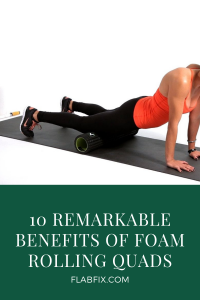
A foam roller is a simple tool that looks like a fat tube. To foam roll quads, you place your thighs above the roller and slowly move back and forth across the top of the roller.
It is an effective tool to add to your workout to ensure the best results.
Using a foam roller is also like giving a self-massage.
The idea behind it is that if you foam roll your muscles, you stretch and massage the tissue.
BENEFITS OF FOAM ROLLING QUADS
1. REDUCE SORENESS
Foam rolling can help reduce muscle soreness and reduce inflammation. It can also speed up muscle recovery time after a workout.
A study of eight physically active men found evidence that shows foam rolling after exercise may help reduce delayed onset muscle soreness.
The eight men foam rolled 20 minutes after exercise. They repeated this 24 hours then 48 hours after exercising.
The study found that those who foam rolled had reduced muscle soreness and performed their exercises better.
The study isn’t broad enough to conclude whether foam rolling completely alleviates muscle pain but it does reduce soreness.
2. INCREASED BLOOD FLOW
One of the other benefits of foam rolling quads is improved blood circulation.
Research suggests that foam rolling benefits the cardiovascular system. Seven men and three women who had not exercised for over a year were assigned to two groups.
One group performed foam rolling for their legs, neck and shoulders while the other group didn’t do any foam rolling.
The participants’ measurements monitoring blood flow were taken before and after foam rolling sessions. At the end of the study, the participants who foam rolled had reduced blood vessel stiffness.
Additionally, another study found that arterial blood flow in the thigh increased directly after, and 30-minutes after foam rolling.
3. TEMPORARILY REDUCE THE APPEARANCE OF CELLULITE
Foam rolling is a self-myofascial release technique.
Fascia is a thin casing of connective tissue that surrounds and holds every organ, blood vessel, bone, nerve fibre and muscle in place.
Since cellulite is caused by fibres that course through fat and cause dimples, it is possible that consistent foam rolling will temporarily smoothen your skin.
There is no scientific evidence that foam rolling permanently gets rid of cellulite.
4. INCREASE FLEXIBILITY
An analytical study shows that foam rolling before exercise can help you improve your flexibility briefly.
It is important to note that it’s not scientifically proven rather speculation that people who pre-foamed experienced increased flexibility because of increased blood flow.
In addition to that, foam rolling mobilizes the fascia back to a gel-like state and increases the muscular temperature.
5. BACK PAIN RELIEF
Another benefit of foam rolling quads is alleviating back pain.
If you use your quads in a rigorous exercise like cycling, you can end up with back pain.
This is because your thigh muscles become shortened and pull the pelvis down which can cause the spine to become tight leading to pain and discomfort.
Studies have shown that foam rolling an ease pain in the body, therefore foam rolling your quads can help ease tension in your back.
6. INCREASE RANGE OF MOTION
Foam rolling your quads can help increase your range of motion.
Range of motion refers to the distance a joint can move and the direction in which it can move.
A study with 33 subjects who didn’t have injuries and were physically active found that those who used dense foam rollers had increased hamstring range of motion.
Another study found that a combination of foam rolling and static stretching increased range of motion. 11 adolescent athletes were used for this study which observed the benefits of foam rolling or static stretching alone.
You will ensure the best results when you stretch tight quads and foam roll after every workout.
7. HELPS YOU RELAX
Many people say that foam rolling helps them relax. Foam rolling reduces tightness in muscles so this may help you reduce stress and tension.
A small study found that foam rolling doesn’t reduce stress more than resting.
However, if foam rolling helps you feel less stressed, you should keep it in your post-workout routine.
8. REDUCES RISK OF INJURY
After a strenuous workout, it is best to get a full body massage to avoid injury.
In the event you can’t afford to or don’t have the time, foam rolling is a perfect substitute.
Workouts can make your muscles tighten and form knots.
Foam rolling works by massaging away fascia build up in your muscles. This prevents those areas from becoming injury trigger points.
Studies show that foam rolling before, during breaks and after a game helps prevent sports-related muscular injury.
9. MANAGE CHRONIC PAIN
Foam rolling is known to manage fibromyalgia symptoms.
Fibromyalgia is a disorder that is characterized by widespread muscle pain and tenderness. Other symptoms include fatigue, altered sleep, memory and mood.
A study of 66 adults living with fibromyalgia found that foam rolling helps manage their symptoms.
The participants who foam rolled did it for 20 weeks and reported that they slept better, and had less muscle pain and stiffness than those who didn’t.
However, it is important to note that further research is needed to uncover the complete range of effects of foam rolling on fibromyalgia.
10. FACILITATES WEIGHT LOSS
Collectively, all the benefits of foam rolling quads lead to reduced fatigue, faster recovery time and lowered risk of injury.
This means that you can exercise more frequently which can help you reach your fitness goals.
Foam rolling encourages deeper muscle activation and improved blood flow. This makes your fitness journey a lot easier to manage since you don’t have to worry about post-workout soreness.
Now that you know about the benefits of foam rolling, here are some things to consider about it.
IS IT GOOD TO FOAM ROLL EVERY DAY?
According to self.com, you should foam roll your muscles almost every day for the best possible results.
To ensure the you experience all the benefits of foam rolling quads, you need to be consistent. It is also best to do it before or after workouts especially where you’re feeling tight.
You should only foam roll your muscles. Avoid doing it to small joints such as your knees, elbows and ankles.
If you are a beginner, you can foam roll at least three times a week.
HOW LONG SHOULD YOU FOAM ROLL QUADS?
Overworking your tissues can lead to injury.
It is best to limit rolling to 30 to 90 seconds for your quads with 10 seconds of stretches or rest in between for about ten minutes to ensure you decrease soreness.
This will ensure you don’t hurt yourself and increase your chances of getting all the benefits of foam rolling quads.
SHOULD YOU STRETCH AND FOAM ROLL?
Static stretching is extending a muscle to the end of its range of motion and holding it. Some athletes believe that it is best to stretch after exercising.
Before your activity, you should do dynamic stretches. These are continuous movement where the muscle goes through the full range of motion.
In a study mentioned above, the research found that combining static stretching and foam rolling helps increase your range of motion. Thus, it would be best to incorporate both activities into your workout routine.
CONCLUSION
Foam rolling has remarkable benefits and when combined with our 28 fat blasting workouts, you are sure to reach your weight loss goals in the shortest time possible.