


Do you want to increase the calories burned while sprinting? The solution you have been looking for could be interval sprints.
Interval sprints are what they sound pretty much alike. For a fixed amount of time (an interval), you sprint out fully (100 per cent speed) and then take a rest afterwards.
Your rest time will usually be twice the duration of the sprinting interval so that what you just put your body through will catch up with your heart and lungs.
During your usual running routine, you then repeat this 4-5 times. You want to run at your usual running pace during your rest period (or slightly slower).
You may want to only walk for that period when first adding interval sprints to your workout instead of doing your normal pace before your body gets used to it.
In between sprints, you may want to take a longer break. It’s all up to you and how, after these sprints, your body feels.
You want to give every sprint a hundred per cent, so if you have to rest longer, do it.
Start by making sprinting easy at first, especially if you have had any heart or breathing problems in the past, and always consult a doctor before beginning any routine exercise.
BENEFITS OF INTERVAL SPRINTING
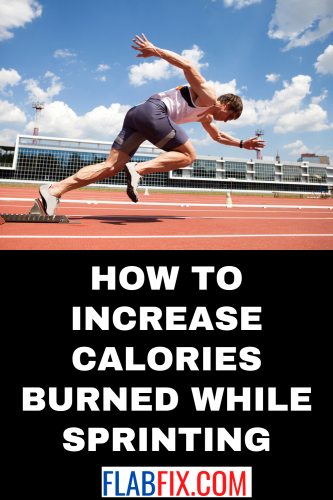
Besides increasing calories burned while sprinting, interval sprinting has other several benefits, including;
BETTER ABS
Chances are, if you want better abs, you may need to get rid of the fat that’s covering them. Interval sprinting is the best way to burn off those love handles and reduce belly fat fast.
This is because this form of sprinting repairs your metabolism by reducing inflammation and improving its ability to burn and use energy.
LEANER LEGS
By increasing calories burned while sprinting, interval sprinting tends to help you lose fat from all parts of your body but especially your lower body.
Interval sprinting will build muscle in the glutes, thighs, and calves.
LEAN AND SUSTAINABLE BODY COMPOSITION
The true power of exercise for generating fat loss has been said to be in its capacity to generate muscle; this raises the overall net burning calories over a day, every day.
In addition to weight training, the only way to achieve this is by making interval sprints. You lose muscle on the endurance-style cardio since it’s catabolic in the long term.
FIX A BAD METABOLISM & PREVENT DIABETES
By building muscles, you increase the muscles’ responsiveness to insulin and the demand for glucose.
You also reduce inflammation and contribute to better body composition by improving fat burning and overall body hormonal balance.
INCREASED BODY BALANCE
Interval sprints improve power and coordination by priming the nervous system so that you can react faster and take a faster first step.
They also build fast-twitch muscles, which are the muscle fibres most associated with preventing falls in the elderly.
This is another reason why interval training is preferred over cardio exercise because we must prioritise coordination and mobility as we age.
GET MORE POWERFUL
Power is the ability to express power quickly. It’s not enough to be strong.
To truly achieve your power potential, you also need to train the body to use the stretch-shortening cycle, which is the elastic component of the muscle.
Any explosive interval training will do this, whether it’s all-out track sprints, stairs running, or cycle ergometer intervals.
Not only will maximum intensity intervals boost power, but you’ll find that lower intensity workouts are much easier.
Other ways to increase calories burned while sprinting include;
BODY WEIGHT
Your body weight significantly affects the number of calories burned while sprinting. A larger body exerts more effort and spends more energy at the same pace as a smaller individual.
A heavier person burns more calories sprinting than someone who weighs less, even if they’re sprinting at the same pace for the same amount of time.
GENDER
Typical adult females have more fat than males in proportion to muscle. Females have a metabolic rate of 5–10 per cent lower than males of the same height and weight.
SPEED
Upgrading your speed and intensity requires more oxygen, which increases your calorie burn. Therefore, if you sprint at a higher speed, a higher number of calories is burned.
INCLINE
Walking, running, or sprinting uphill burns more calories than going downhill or on a level surface. Depending on the incline, an extra 3 to 5 calories per minute is burned.
HOW DO YOU CALCULATE CALORIES BURNED WHEN RUNNING?
When we run, we often look for the benefits that come with it, like losing weight and improving fitness.
The running calorie calculator or the jogging calorie calculator helps you know how many calories you burn after running or jogging.
It can also supply how many calories you burned on your treadmill. Calories burned while sprinting will depend on your weight, time spent running, and speed.
Scientists use a unit called MET or a metabolic equivalent of a task to estimate the number of calories burned (MET).
The total number of calories burned for each task is calculated by first finding the calorie burn per minute.
This is done by multiplying the task’s MET value by the bodyweight of the person in kg and 3.5 and then dividing that number by 200.
The calorie burn per minute is then multiplied by the amount of time the task is performed to find the total calories burned by the activity.
HOW MANY CALORIES ARE BURNED FROM SPINNING?
The average person burns 250-330 calories per hour at 40 watts and 630-840 calories per hour at 100 watts.
The amount of calories burned while spinning depends on your weight and the intensity of your activity. The formula for calculating calories burned from spinning is as below;
Calories burned per minute = (MET x body weight in Kg x 3.5) ÷ 200
HOW MANY CALORIES DO YOU BURN WHILE STRETCHING?
The average person burns 165-220 calories per hour doing mild stretching. The formula for calculating calories burned from spinning is as below;
Calories burned per minute = (MET x body weight in Kg x 3.5) ÷ 200
Where MET is the measurement of the energy cost of physical activity for a while.
CONCLUSION
Don’t sprint too fast at the beginning. Your body needs to get used to the new stress and strains of running.
Starting to sprint too fast can lead to frustration, over-exercise, pain, and injury. So start at a moderate pace.
If you are a new runner, initially sprint at short intervals. Increase your sprinting intervals by one minute per workout until you can run the entire distance without walking.
After the workout, give your body a rest to recover and be prepared for the next session. This is going to help you work out more in the long run.
Don’t strain your body needlessly. Take short and easy steps, and feel relaxed and comfortable.
Your body would develop the coordination needed to perform a complex sequence of movements with every kilometre or mile you decide to sprint.