
Looking for a great stretch exercise to pump blood in your lower body before a good old-fashioned leg day workout? Look no further than the low lunges, which is today’s feature. The low lunge stretches and works the quads, hamstrings, glutes, hips, and calves.
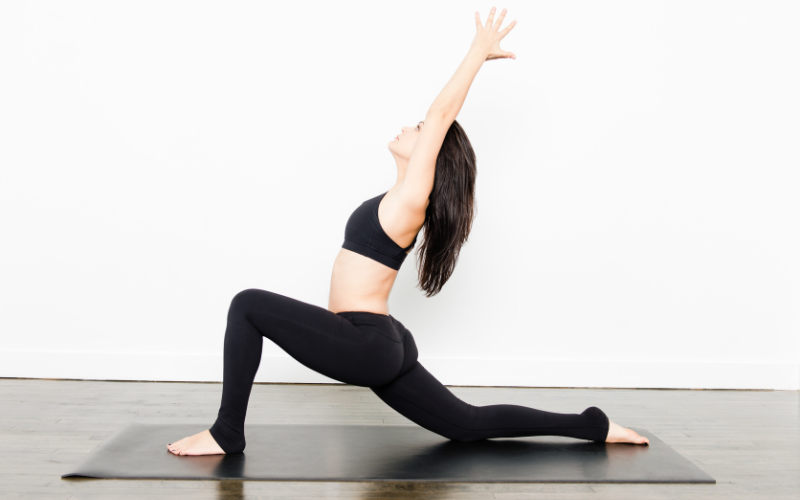
The low lunge we cover is not to be confused with the low lunge pose in yoga. They may be similar, but they are completely different in their own right.
The low lunge is a powerful exercise that not only stretches out your leg muscles but also can be a full leg day workout if sufficient resistance is incorporated by use of dumbbells or kettlebells.
A two-in-one package. Sound like a pretty good deal.
HOW TO DO LOW LUNGES
Here is how you can do low lunges;
- Requirements: No equipment is required.
- Set–up: Get into a standing position with your right foot about 2 feet in front of the left foot. Your torso is upright and straight and your shoulders back and down. Have your core engaged and hands resting on your hips.
- Execution: Lower your body by bending your knees until the back knee is just above the floor. When you reach the bottom of the movement, the front thigh is parallel to the ground and the back knee points downwards. Your weight should be evenly distributed between both legs.
- Push your feet into the ground back to the starting position, keeping your weight on the front foot’s heel as you transition. Switch leg positions and repeat to complete a rep. Do as many reps as you are comfortable with.
As you can see it is a pretty simple exercise. You can check out this video for a visual demonstration of the low lunges. Now let us see what muscles are stretched and/or worked by the exercise.
WHAT MUSCLES ARE WORKED BY THE LOW LUNGE?
The low lunge works quite several muscles in the lower body, namely; the quadriceps, hamstrings, glutes, hip flexors and calves. Its fair to say it works the entire leg.
QUADRICEPS

The quadriceps femoris, more commonly known as the quads, acts as a hip flexor and knee extensor. It consists of 4 muscles; the rectus femoris and 3 vastus muscles.
They form the main part of the thigh making them one of the strongest muscle group in the body. Do a couple of low lunges and your quads will be nice and ready for a nice workout.
HAMSTRINGS

Hamstrings have nothing to do with ham. They are a group of 3 muscles; semitendinosus, semimembranosus and biceps femoris, that primarily help flex the knee.
They make up most of the back of the thigh. They help in basic mobility functions such as walking.
GLUTES

The glutes, more commonly referred to as the butt, being the largest and longest muscle group, are essential for development. There are 3 muscles that form the glutes; gluteus maximus, gluteus minimus and gluteus medius. Like other lower body muscles, they help in basic motions such as rotation and walking.
HIP FLEXORS

The hip flexor muscle, as you would guess, is responsible for flexing the hip i.e., bringing the knee towards the chest. Yes, every step you take relies on these muscles. Low lunges get the blood pumping into your hip flexors, preparing them for more tedious exercises.
CALVES

This exercise also hits the calves, which are the back portion of the lower leg. Well-developed calves go a long way in helping in walking and running since the calf muscle pulls the heels up to allow for forward movement.
BENEFITS OF THE LOW LUNGE EXERCISE
So, what exactly are the benefits of this particular exercise?
PREPARATION FOR PROPER WORKOUT
The low lunge is a primer to a more engaging lower body exercise like the deadlifts and weighted squats. The exercise warms up the body and ensures your body is ready to ease into a more difficult exercise, especially for muscle gain.
WEIGHT LOSS
The low lunge may not be the exercise of choice to gain muscle but it is by all means, a great exercise to lose weight.
BALANCE AND STABILITY
The single leg movements of the exercise activate your muscles responsible for stabilization thus developing coordination, balance and stability.
ALTERNATIVES TO THE LOW LUNGE
Here are some other excellent alternative exercises for your lower body;
GLUTE BRIDGES
This move targets the glutes and hamstrings without putting strain on the knees. Here is how you do it;
- Requirements: No equipment is required.
- Lie on your back with your knees bent. Your feet should be in line with your sit bones. Squeeze your abs and press your arms into the ground at your sides. Squeeze your glutes, lift your hips from the floor, and ensure your spine is in a neutral position to avoid injury.
- Lower your hips to the floor and repeat the cycle for reps. 10-30 reps is the sweet spot.
STEP-UPS
This exercise strengthens the same muscles that help transition your body weight through vertical movements. Here is how it is done;
- Requirements: Elevated platform such as a chair.
- Stand in front of the platform and have your left foot on top of the platform and lift your body up to stand on top of the chair. Be sure to have your spine upright throughout the process and your hands at your waist or in a neutral position.
- Repeat the process with your left foot and repeat the cycle for reps.
To make this more challenging, hold a pair of dumbbells or kettlebells in each hand.
MISTAKES TO AVOID WHEN DOING THE LOW LUNGE
NOT STEPPING FORWARD ENOUGH
Your forward leg in the lunge should be forward enough to create a true 90-degree bend.
ROUNDED SHOULDERS AND BACK
This is arguably the most common mistake. Do not bend your back or shoulders as this may lead to unnecessary strain. Instead, have your back straight and shoulders in their neutral position.
FAILURE TO BEND BOTH KNEES SIMULTANEOUSLY
When you bend your front knee, your back knee should also be bent. Also do not let your front knee get past your toes; aim for a 90-degree angle.
CLOSING REMARKS
If you ask any fitness expert the surefire way to get toned legs, they will probably mention ‘the lunge’.
This exercise is an absolute staple for any lower body workout and this cannot be overemphasized. The low lunge is just a variation of the lunge.
The exercise is backed by years of research and I see no feasible reason not to include this to our workout plans even if it is just as a warm-up exercise.
Get those lunges in, to get those gains in!