
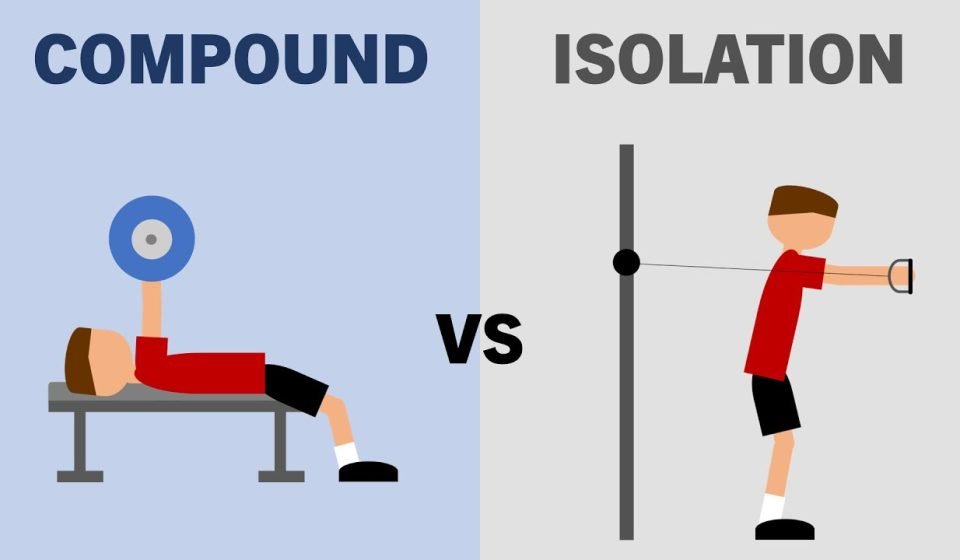

If you are starting strength training, you will often hear two common terms: compound exercises and isolation exercises. Many beginners get confused about which type of workout they should focus on.
Both training styles help build muscle and improve fitness. But they work in different ways.
Compound exercises train multiple muscles at the same time, while isolation exercises focus on one specific muscle group.
Understanding the difference can help you build a more effective workout routine and see better strength results.
In this guide, you will learn:
-
What compound exercises are
-
What isolation exercises are
-
The benefits of both training styles
-
Which one is better for building strength
What Are Compound Exercises?
Compound exercises are movements that work multiple muscle groups and joints at the same time.
Instead of targeting a single muscle, these exercises train several muscles together. This makes them very effective for strength training and functional fitness.
Some popular compound exercises include:
-
Squats
-
Deadlifts
-
Bench press
-
Pull ups
-
Push ups
For example, when doing push ups, your chest, shoulders, triceps, and core muscles all work together.
Benefits of Compound Exercises
Compound workouts offer several advantages:
1. Build Strength Faster
Because multiple muscles work together, you can lift heavier weight and build overall strength more efficiently.
2. Save Time
You train several muscle groups in one movement. This makes compound workouts great for people with limited time.
3. Burn More Calories
Large muscle movements require more energy, which increases calorie burn.
4. Improve Functional Strength
These exercises mimic real-life movements like lifting, pushing, or pulling.
What Are Isolation Exercises?
Isolation exercises target one specific muscle group and involve only one joint movement.
They are commonly used in bodybuilding or muscle correction training.
Examples include:
-
Bicep curls
-
Tricep extensions
-
Leg extensions
-
Hamstring curls
-
Lateral raises
For instance, when doing bicep curls, the main muscle working is the biceps, while other muscles stay mostly inactive.
Benefits of Isolation Exercises
Isolation workouts also play an important role in strength training.
1. Target Specific Muscles
If a muscle is weak or underdeveloped, isolation exercises help focus on it.
2. Improve Muscle Definition
Bodybuilders often use isolation exercises to shape specific muscles.
3. Fix Muscle Imbalances
If one muscle group is weaker than another, isolation training can help correct it.
4. Safer for Beginners
Some isolation movements are easier to learn and control.
Compound vs Isolation Exercises: Key Differences
| Feature | Compound Exercises | Isolation Exercises |
|---|---|---|
| Muscles Worked | Multiple muscles | One muscle |
| Joint Movement | Multiple joints | Single joint |
| Strength Gains | Faster strength improvement | Slower strength gains |
| Calorie Burn | Higher | Lower |
| Best For | Strength and overall fitness | Muscle shaping |
Which Is Better for Strength Training?
If your main goal is building strength, compound exercises are generally better.
Here is why:
1. Greater Muscle Activation
Compound movements recruit more muscle fibers, which leads to stronger overall muscle development.
2. Progressive Overload
You can increase weight more easily with compound lifts, which is important for long term strength gains.
3. Better Hormonal Response
Heavy compound exercises stimulate more muscle building hormones compared to single muscle exercises.
When Should You Use Isolation Exercises?
Isolation exercises are still valuable and should not be ignored.
You should include them when:
-
You want to improve muscle symmetry
-
A specific muscle is weak
-
You want better muscle definition
-
You are recovering from an injury
Many strength programs combine both training styles.
Best Compound Exercises for Strength
Here are some of the best compound lifts for building strength:
One of the most powerful lower body exercises. It trains the quads, glutes, hamstrings, and core.
Deadlifts work the entire posterior chain including the back, glutes, and hamstrings.
Push ups strengthen the chest, shoulders, triceps, and core muscles.
Pull ups are excellent for developing upper body strength and back muscles.
A classic strength exercise for chest, shoulders, and triceps.
Best Isolation Exercises for Muscle Growth
Isolation exercises are perfect for targeting specific muscles.
Popular options include:
Focuses on the biceps and helps improve arm size.
Strengthens the triceps and improves arm definition.
Targets the quadriceps muscles.
Develops shoulder width and shape.
How to Combine Compound and Isolation Exercises
The best workout routines combine both types of exercises.
A common structure looks like this:
Start with compound exercises
-
Squats
-
Bench press
-
Pull ups
These require more energy and strength.
Finish with isolation exercises
-
Bicep curls
-
Tricep extensions
-
Lateral raises
This allows you to target smaller muscles after the main lifts.
Simple Strength Training Workout Example
Here is a balanced strength workout routine:
Compound Exercises
-
Squats – 4 sets
-
Push ups – 3 sets
-
Pull ups – 3 sets
Isolation Exercises
-
Bicep curls – 3 sets
-
Tricep extensions – 3 sets
-
Lateral raises – 3 sets
This combination helps build both strength and muscle definition.
Final Thoughts
Both compound and isolation exercises play important roles in a strength training program.
Compound exercises are the best choice for building overall strength, improving athletic performance, and saving workout time.
Isolation exercises are useful for targeting specific muscles, fixing imbalances, and improving muscle definition.
For the best results, combine both training styles in your workout routine. This balanced approach helps you develop strength, muscle size, and overall fitness.


