

Exercising has become a norm in the 21st century but working out your body calls from high-level knowledge on different types of stretching.
Stretching targets a specific muscle or tendon and work it up by flexing. The aftereffect is creating more elasticity and good muscle tone, which increase the range of motion.
Besides, it is also important to understand in depth the benefits of each type of stretching and how to do it.
Whenever you are exercising, stretching comes up as a mandatory exercise. Therefore, more knowledge of how it should be done is the icing of the cake.
If you are a fitness enthusiast, you already know that improving muscles and mobility functionality are some of the key benefits of stretching.
From a general point of view, stretching cushions you from, reduce muscle stiffness and stiffness.
There are five different types of stretching – the main ones – which are widely used when exercising.
5 COMMON STRETCHES
The list of different types of stretching is quite huge. The most common types of stretching are passive stretching, ballistic stretching, active stretching, dynamic stretching, isometric stretching and PNF stretching.
10 DIFFERENT TYPES OF STRETCHING AND THEIR BENEFITS
1. PASSIVE STRETCHING
Passive stretching ranks high in the charts of different types of stretching. It is also known as relaxed stretching.
There are different types of passive stretching.
Supine single leg stretch, standing quadriceps stretch, doorway stretch, quadriceps stretch, hamstrings stretch, recline butterfly stretch make up passive stretching.
It involves staying in one position while performing the stretch. Usually, you do it for a couple of minutes.
You assume one position and support it with one part of the body or with support from an assistant. Passive stretching has you very relaxed.
You can do a passive stretch by raising the leg high up and hold it with your hand. Also, you can lie on the floor, bend the leg while lifting it upwards and supporting it with your hand.
The major benefit of passive stretching in relieving spasms in the muscles and facilitating quick healing after an injury. It also cools down the body after an intense workout while also reducing fatigue, soreness and muscle fatigue.
2. STATIC STRETCHING
Static stretching involves stretching the muscle to the farthest point possible. Some external force is required to increase the stretch, unlike in passive stretching where you are greatly relaxed.
The muscles are stretched to the farthest position while holding to the same position for 20 seconds. This is what brings about a range of motion.
Each stretch targets a specific muscle to the maximum point. When sitting down, reach for your toes and have your back loosen a bit. You can also lie on your stomach and pull the leg closer to your back.
It is recommended to have static stretches before you embark on light activities which increase the heart rate. They warm up the body.
Static stretching enhances the functionality of all specific muscles being worked. It builds endurance and increases the range of motion too.
3. SHOULDER STRETCH
Flexing the shoulders joins the list of different types of stretching. In most cases, you perform shoulder exercises while standing.
While standing and arms by the side, you lift the shoulders upwards and holds for 10 seconds. You repeat this severally.
Shoulder stretches ease pressure on the shoulders, relieves pain, improves posture and increases mobility.
If you train hard, it reduces the chances of muscle and joint injury.
4. HAMSTRING STRETCH
This one targets the hamstring muscle. You lie on the flat on the ground with your back, feet on the ground and bring the knee slowly bringing it close to the chest. Hold this position for 30 seconds and repeat severally.
Hamstring stretch lowers back pain, reduces injury, increases the range of motion and improves posture.
5. DYNAMIC STRETCHING
If you are into sports focusing on a range of motion, dynamic stretching could be good for you.
It sums up the importance of different types of stretching as it moves muscles and joints while imitating the movement requirements of the sport of your choice.
Usually, it works the arms and shoulders which are involved in the creation of momentum.
This stretching’s benefits are that it warms up the body before exercising and increases the range of motion.
6. BALLISTIC STRETCHING
Ballistic stretching is used more in athletic drills. It is characterized by a repetitive bouncing movement which stretches each targeted muscle group.
More often than not, ballistic stretching is preceded by static stretching to reduce the chances of injury likely to come about due to extreme stretch reflex.
It prevents muscle soreness which is common among athletes.
7. ISOMETRIC STRETCHING
This one does not use motion. It brings resistance to muscles by creating tension in muscles which are already stretched.
Huge resistance in the muscles increases endurance and flexibility. Stretched muscles become stronger.
Isometric stretching also alleviates pain that comes about as a result of stretching.
8. PNF STRETCHING
Proprioceptive Neuromuscular Facilitation (PNF) is a combination of stretching techniques geared towards bringing back the range of motion.
It involves bringing together active and passive stretching into one stretch. However, it lowers the risk of suffering from an injury and facilitates quick recovery from any training-related injury.
9. ACTIVE STRETCHING
The secret behind active stretching is that it takes one position and targets a specific muscle from a whole group and works it up.
Active stretching involves the action of agonist and antagonist muscles. They work without getting aid from external forces.
They are good at releasing tension and promoting muscle elasticity. Muscles relaxation also improves because it works solely on the principles of neurological principles of movement.
10. MYOFASCIAL RELEASE
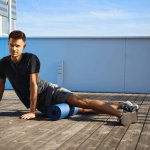
Myofascial release stretching enlists the use of a foam roller which you rests your back on with the knees bent at 45 degrees and roll back and forth in the same position.
It targets the fascia, which is a delicate part of the body’s connective tissue makeup. You repeat the movements for 30 to 60 seconds.
Myofascial is key in reducing pain from an injury by reducing muscle soreness and improving blood circulation and the range of motion.
CONCLUSION
Depending on what you want to achieve and the level of training you are undergoing, you use this information to guide you on your choice of different types of stretching.
Each type of stretching has a unique set of benefits. You can choose whichever suits you best.