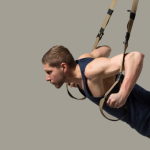


The trx squat should be in your training regimen if you want a more muscular lower body.
Working out your glutes positively affects your legs, which you achieve with this squat variation.
The beauty of it is that you achieve your fitness goals quickly because you simultaneously target several muscle groups.
You eventually increase core stability and body balance by working the glutes, quadriceps, hip flexors, and hamstrings.
Here is how you perform the trx squat.
- Install a TRX or suspension trainer on a door or anchor that is easily accessible.
- Make adjustments to the handles and loosen the straps.
- Bring them back towards you.
- Make sure the anchor is strong enough to sustain your weight.
- Take a few steps back until you’re around 80 to 100 centimeters from the anchor.
- The handles of the TRX should be about knee-level when you stand next to it.
- Make sure the handles are parallel in length by gripping them.
- Spread your feet by keeping a shoulder-width distance in front of the anchor.
- Your hands should be about midway down your arms if you’re standing.
- Position yourself in a straight line with your elbows resting just below your shoulders – it should be 1800.
- Squat with your knees bent at a 90-degree angle.
- Your arms should naturally elongate as you lower yourself.
- Return to a standing position by pressing your heels into the floor.
- Keep your back straight while you squat.
WHAT MUSCLES DOES TRX SQUAT WORK?
The trx squat is an excellent option for strengthening your legs while using your body weight.
You end up working the following muscles in the process.
GLUTES

Gluteal muscle aid in thigh movement – away from the midline – during the workout. It also keeps the pelvis and hips sturdy before, during and after exercising.
QUADRICEPS

Your quadriceps stretch and straighten the knee during the squat. These muscles are crucial because they allow you to walk, run, jump and even swim out of knee extension function.
HIP FLEXORS

Hip flexors facilitate lower body movement. Like the glutes, they play a crucial function in daily movements such as walking, running and jumping.
CALVES

The calf muscles support your lower body movement by flexing the feet, enabling you to walk or jump easily.
ABDOMINALS

The abdominals play the role of a supporting muscle. They hold the trunk and work with core muscles to align and stabilize the spine.
TRX SQUAT BENEFITS
You could be up to the challenge of the trx squat, but do you know the advantages it gives you? Read on and find out.
BUILD MASSIVE LEGS
Strong legs are essential because they support the rest of the body. And the squat gives you this with every single rep you make.
FANTASTIC FOR BEGINNERS
Squatting with the TRX is a terrific tool for beginners or those just seeking to improve their technique.
It is particularly helpful for adolescents looking forward to starting their fitness journey.
GOOD CHOICE FOR PEOPLE WITH LIMITED MOBILITY
The TRX is a safe and adaptable tool anyone battling measured joint mobility and flexibility can turn to.
It has a broader range of motion, giving a better scale of joint mobility.
LOW-RISK WORKOUT
Training your lower body engages the core, which is critical in keeping your spine safe. Besides, the trx squat improves your balance and posture, relieves you from an injury.
ALTERNATIVES TO TRX SQUAT
Any squat you perform targets primary muscles in your lower body. They work your glutes, calves, hamstrings, quadriceps, and core.
The trx squat is one of them, but several other alternatives give you a fiery lower body workout.
TRX PISTOL SQUAT
Performing the pistol squat demands a lot of leg strength, but it rewards you with flexibility and proper balance.
Technique:
- Make sure the anchor point is facing you, and grab the handles.
- Take a step in front of you with one leg.
- As you lower yourself into a squat, maintain your heel firmly on the floor and bend your supporting leg.
- Leap one leg and land on the other as you propel yourself up and away.
- Alternate between each leg, jumping on one leg at a time.
TRX SINGLE-LEG SQUAT
The trx single leg squat engages a wide range of muscles.
Technique:
- Ascertain that the TRX suspension is firmly in place and lifted.
- Take hold of the handles with both hands and place them at your sides.
- Keeping your weight on the bent leg, lift the leg in front of you and move your weight to the opposite leg.
- Flex the raised foot towards you.
- Put yourself in a sitting position by squatting with your back straight.
- Use the suspension handles to help you get back to your starting position from the low squat.
TRX SPLIT SQUAT
You can go lower in this position than in a regular squat, which benefits hip mobility.
Technique:
- Attach the trx band to an overhead structure for firm support.
- Double-thread the handles and hang them.
- Use the grip to bring one leg back while putting your foot through while one knee is on the ground.
- Maintain some TRX band tension, but not too much that it slips off your foot.
- Extend your lead leg in front of you.
- The back knee should be on the ground.
- The front knee should be in front of the body,
- Make sure your leading knee does not go too far in advance of your foot when you rise from the ground.
- Keep your hips square and your lead foot in line with your hip as you ascend.
- Take a gradual and steady descent, then blast upwards.
TRX SQUAT MISTAKES TO AVOID
You could be making the following trx squat mistakes.
- Lifting yourself while on your toes and heels – interferes with weight distribution.
- Not aligning your ankles with your knees.
- Failing to keep a neutral spine – ends up in injury.
- Not keeping your shoulders back and down.
CONCLUSION
It’s critical to learn to use your weight as resistance, especially when you want to increase your flexibility. Trx squat gives you a perfect avenue to kick-start your fitness journey by working your lower by like never before.