
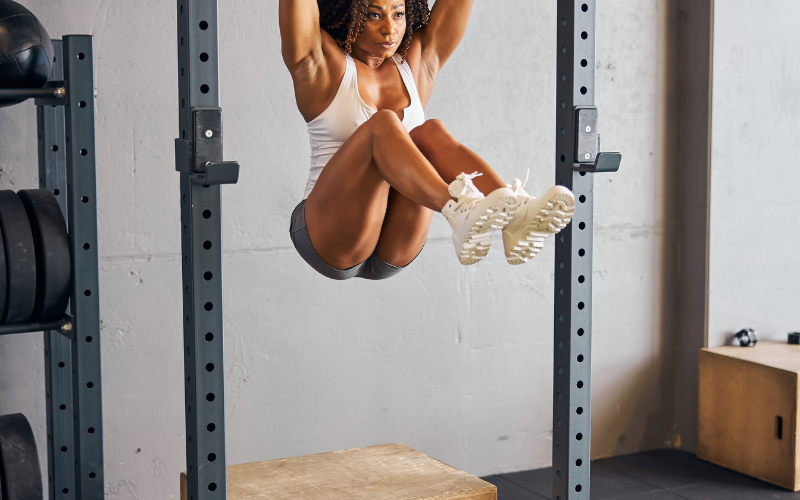

Ever wondered what it feels like to perform a record-breaker exercise that fitness experts have recognized? Well, this is it. The vertical knee raise was ranked 2nd best in the list of best exercises for targeting the rectus abdominus.
This was according to a study done in San Diego State University, which compared 13 common abdominal exercises to determine the ones that targeted the abs.
The vertical knee raise is a core workout that will enable you to add variety to your abs routine while raising it to a new and advanced level.
If you aim to have the elusive six-pack, this record-breaker exercise will help you along your way. You can use it as part of a core or total body workout.
Enough spoilers. Let us discuss more about this exercise that can thoroughly work your abdominal muscles when done correctly.
HOW TO DO VERTICAL KNEE RAISE PROPERLY
You will need access to a dip/raise machine to perform this exercise.
Below is a step-by-step guide to ensure you perform this exercise correctly for maximum benefit.
Begin by positioning yourself on a dip/raise machine with your back against the pads and your arms holding up your body by resting on the parallel bars.
Use the handgrips to hold on to the ends of the parallel bars and the foot bars to step up onto your starting position.
Take your feet off the support and allow them to dangle. Inhale at this point.
While exhaling, slowly bend your knees and begin to lift them towards your chest. This motion should be slow and controlled for effectiveness. (Note that if you have a bad knee, you can rely on knee support materials to help with this motion).
Keep bringing your knees up until your thighs are parallel to the floor.
Continue to further list your knees past the parallel points without rounding your back off the backrest and looking down. The further you lift above the parallel point, the more you will work your abs.
While inhaling, slowly return your legs to the starting position. Repeat for the desired number of reps.
VERTICAL KNEE RAISE TIPS TO CONSIDER
You may need to stay clear of this exercise if you are pregnant, recovering from childbirth, have rectus diastasis, had a recent abdomen surgery or recovering from injuries involving your arms, back, neck or legs.
If you feel any pain while on set, stop immediately and ask your trainer for alternatives that you can use.
COMMON VERTICAL KNEE RAISE MISTAKES TO AVOID
Get the most out of this exercise by avoiding the following errors.
ALLOWING YOUR LEGS TO DROP
While completing the rep, avoid allowing your legs to drop as you will lose half the benefit of the exercise. While returning to the starting position, perform slowly and in a controlled manner.
USING MOMENTUM
Avoid doing this exercise fast or swinging your legs up and down as this will use momentum in performing the exercise rather than the wanted muscle. This reduces the impact of the exercise on the target muscles.
EXTENDING YOUR LEGS
If you are new to this exercise, always bend your knees. Extending your legs will activate the hip flexors instead of the required abdominus, thus the attention of the exercise from the main muscle.
VERTICAL KNEE RAISE MUSCLES WORKED
To understand the impact of this exercise to your abdominal muscles, it is key to have an understanding of your abs, each of the muscles it is made up of and what they do.
RECTUS ABDOMINIS

This is the most commonly known and the most prominent abdominal muscle.
It is a long, flat muscle extending vertically between the pubis and the 5th,6th and 7th ribs.
This muscle helps flex the spinal column, narrowing the space between the pelvis and the ribs. Additionally, it is also key in side bending motions.
EXTERNAL OBLIQUES

This pair of muscles is found at each side of the rectus abdominis. Their muscle fibers run diagonally downward and inward from the lower ribs to the pelvis, forming a letter V.
They facilitate the spine’s flexion, torso’s rotation, bending on the sides and compression of the abdomen.
INTERNAL OBLIQUES
These are a pair of muscles that run deep just below the external obliques. They form a right angle to each other together with the external obliques.
Along with the external obliques, the internal obliques play a role in flexing the spinal column, bending sideways, trunk rotation and compressing the abdomen.
HIP FLEXORS
These are a group of muscles that serves to bring together the legs and trunk in a flexion movement.
They are not necessarily abs muscles but facilitate ab movements in several ab exercises such as the vertical knee raise.
VERTICAL KNEE RAISE BENEFITS
The vertical knee raise is an excellent exercise for isolating the abdominal muscles, for building strength in the hip flexors, and developing your core.
While the rectus abdominus will be stabilizing your core during this exercise, your hip flexors on the other hand, will be bringing your knees up.
The main muscles worked by this exercise are the ones you show off: the rectus abdominus.
Besides a generally appealing abdomen, this muscle will also help in spinal flexion to help you in movements such as sitting up from a lying position.
VERTICAL KNEE RAISE ALTERNATIVES
LYING KNEE PULL-IN/ RAISE
This alternative is for those who want to isolate their abdominal muscles but lack efficient upper body strength to perform the vertical knee raise.
BICYCLE KICKS
This alternative will increase abdominal, hip flexors and unilateral core strength and is also a great exercise to help you prepare for the advance vertical knee raise.
TAKE AWAY
This exercise can be modified in different ways to suit one’s fitness level. If you are a beginner, it is safe to use the dip/raise machine as in this exercise compared to parallel bars for advanced-level trainers.